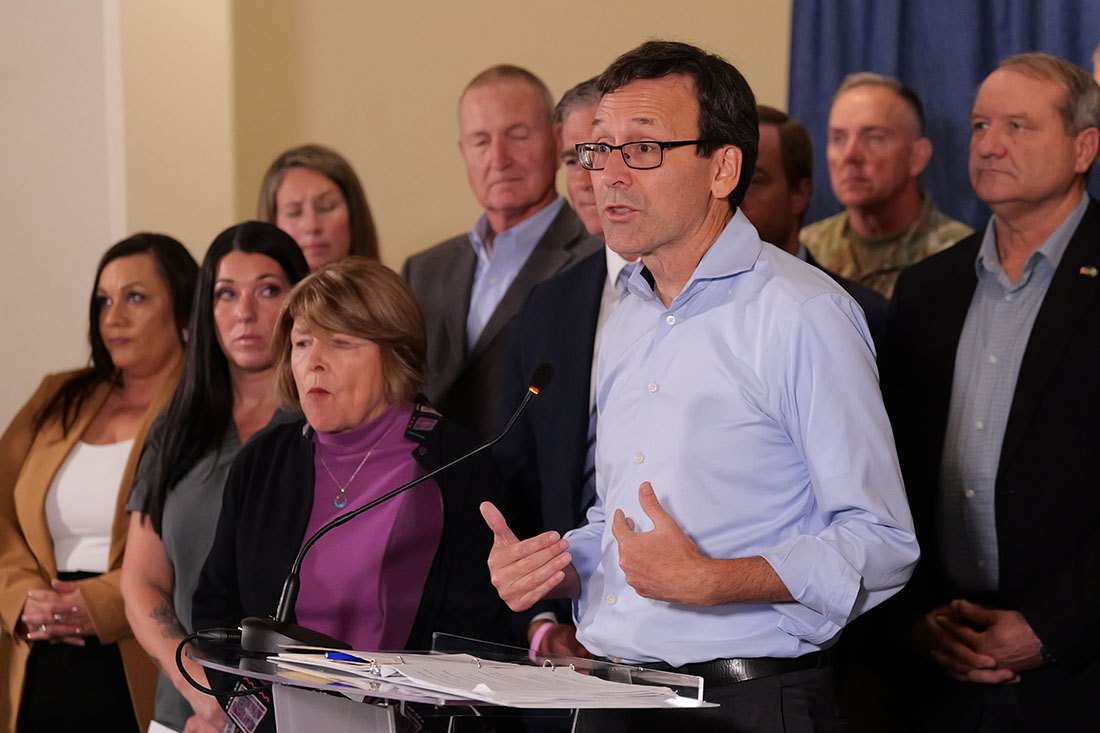
Gov. Bob Ferguson asked President Donald Trump on Monday, Sept. 28, for a federal disaster declaration to unlock $128.9 million in Eastern Washington wildfire aid.
The request, announced at a press conference in Spokane, would direct Federal Emergency Management Agency (FEMA) funds to four counties where fires destroyed 649 homes, damaged 2,542 more and burned nearly 369,000 acres. Ferguson also announced state-level actions to cut rebuilding costs, including proposed legislation that will go before lawmakers in Olympia. Thurston County residents felt the reach of these same fires in August, when smoke triggered air quality alerts across the region.
Ferguson estimated the structural damage alone exceeds $188 million, according to the Washington State Standard.
Lt. Gov. Denny Heck, who led a state review of recovery options at Ferguson's direction, called the combined package the largest disaster-assistance program for individuals in Washington's history.
"The combination of things that are being recommended here are big, big, big," Heck said at the Monday, Sept. 28, press conference, as reported by the Spokesman-Review. "And they deserve to be big, big, big because these people warrant it."
What the federal money would cover
If approved, the declaration would release an estimated $11.2 million in FEMA Individual Assistance for survivors in Benton, Okanogan, Spokane and Stevens counties and the Spokane Tribe of Indians. The program caps payments at $42,500 per person. Residents would need to apply directly with FEMA.
A separate $117.7 million in FEMA Public Assistance would cover debris cleanup and emergency response costs across 11 counties: Asotin, Chelan, Columbia, Douglas, Ferry, Grant, Okanogan, Spokane, Stevens, Whitman and Yakima. The federal government would pay 75% of that total, with the state and counties splitting the rest, according to Robert Ezelle, director of the Washington State Emergency Management Division, as reported by GovTech.
Ferguson said he plans to request additional FEMA Public Assistance for road and infrastructure repairs in October.
State actions announced
Ferguson also announced several state-level measures, according to the governor's office:
- Building code flexibility: Ferguson said he will urge the Washington State Building Code Council to use emergency rulemaking so homeowners can rebuild to the energy code in effect when their home was originally built. Homes built before 2015 could rebuild to 2015 standards. The council has not yet acted on the request.
- Sales tax rebate legislation: Ferguson will propose a bill offering sales and use tax rebates on rebuilding costs after a declared disaster. A homeowner spending $400,000 to rebuild in Spokane could qualify for roughly $36,000 back. State Sen. Marcus Riccelli, D-Spokane, said he plans to introduce the bill.
- Permit fee waivers and debris removal: Ferguson announced he will sign an amendment to his emergency proclamation waiving the state fee on building permits in affected counties, directing the Department of Ecology to grant temporary permit exemptions for debris piles and eliminating the cap on emergency public works grants for impacted cities and counties.
The damage
Spokane County bore the worst losses. Fires destroyed 615 homes there, forced the evacuation of more than 65,000 people and displaced more than 1,900 healthcare workers. In Okanogan County, more than 300,000 acres burned. Stevens County lost 14 homes across three fires, and Benton County saw roughly 40,000 acres burn.
Sherry Merritt lost the Spokane-area home she had lived in for more than 45 years. She spoke at the press conference alongside Ferguson.
"We had no time to gather anything but our medicine," Merritt said, according to MyNorthwest.
More than 900,000 acres have burned statewide in 2026. At least two people have died.
What comes next
No deadline exists for the White House to act. Ferguson noted that a similar flood-disaster request earlier in 2026 took seven weeks to receive a response. The request carries bipartisan support from every member of Washington's congressional delegation and leaders of all four state legislative caucuses.
The state has already distributed nearly $1 million in emergency assistance to more than 600 households from a $2.5 million state fund. About 70% of affected homes carry insurance, but coverage is not expected to fully cover losses.