Fourteen Korean American artists are exploring immigrant life through the lens of the marketplace in a free exhibition at South Puget Sound Community College's Leonor R. Fuller Gallery.
"From Hwagae Market to Pike Place Market," organized by the Korean American Artists Association of Washington, runs through Oct. 16 at the gallery inside SPSCC's Kenneth J. Minneart Center for the Arts, 2011 Mottman Rd. SW.
The gallery is open noon to 6 p.m. Monday through Friday, excluding holidays. Admission is free.
Curator Kellis Partlett, an artist from Seoul, said the show's concept grew from hearing Jo Young-nam's song "Hwagae Market" on the radio, OlyArts reported.
The song, well known among older generations of Korean Americans, describes the lively character of Korea's Hwagae Market, a trading hub on the border of the Gyeongsang-do and Jeolla-do provinces outside Seoul. That image led Partlett to Pike Place Market in Seattle, another gathering place where cultures meet and share food, crafts and art.
The association's exhibition statement describes the show as reflecting how its members built new lives in the United States while holding onto Korean roots.
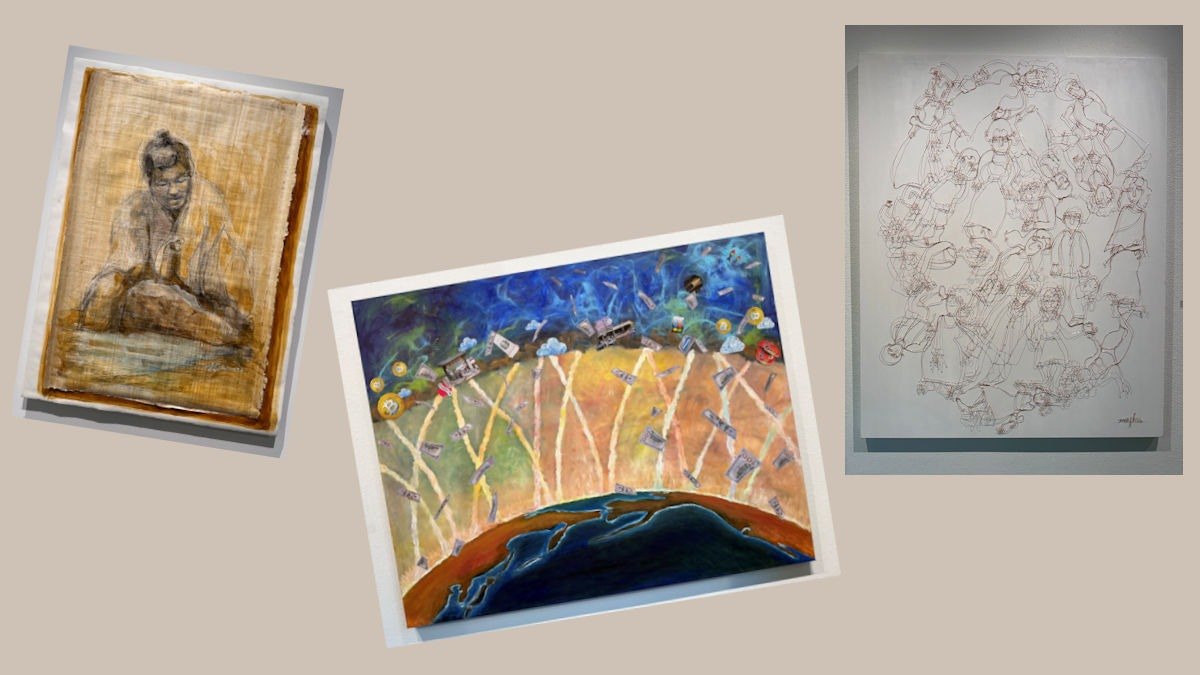
The works span surreal paintings, still life, folk art, collage, wire work and installations. Many carry nostalgia for Korea alongside symbols of life in Washington.
Patsy Surh O'Connell, founder of the Asia Pacific Cultural Center in Tacoma and who has served as president of the association, has two pieces featuring peonies, which symbolize wealth and honor in Korean culture.
One is an 8-foot-tall wallpaper hanging with ink and stitched collage depicting black birds, peonies and samples of Korean fabrics. The other, "On the Way to the Market," sets delicate peonies against a stone wall.
O'Connell is a Washington State Governor's Arts and Heritage Award recipient who has taught water media at the college level for 37 years, according to the Asia Pacific Cultural Center.
Kristin Choi's two fluorescent oil paintings include a circular canvas showing a figure in a white hanbok, the traditional Korean dress, falling down a "Did You Follow the White Rabbit?" hole. Her "The Mugunghwa" depicts South Korea's national flower, the hibiscus, associated with immortality and eternal love.
Bella Kim's installation "Arirang 2.0," named for a Korean folk song believed to be more than 600 years old, cascades from ceiling to floor in recycled fabric circles sewn together. The piece starts white at the top, grows more colorful in the center and darkens toward the bottom, where whole items of clothing become visible.
Emily Jounghee Won's copper wire relief "drawings" depict playful images of people meeting and greeting one another. Sun Hui Watkins contributes "Old Pines in the Mist," an acrylic triptych in traditional Korean ink art style.
Jungho Kim's "Right Here, Like This" uses traditional Korean fabric as a canvas covered in small square mirrors arranged like a fractured QR code, suggesting the disorientation and fragility of potential identity loss in relocation.