Tumwater's 400-year-old Davis-Meeker Garry oak could cost more than $100,000 to save after windstorms tore away nearly a third of its canopy.
The Tumwater Historic Preservation Commission voted unanimously on Thursday, Oct. 15, to recommend retaining the tree and to request an emergency declaration from Mayor Leatta Dahlhoff to fast-track pruning.
The recommendation heads to the Tumwater City Council at a Tuesday, Oct. 27, work session, as first reported by The Olympian.
Commission Chair David Shipley said at the meeting that pruning season begins in late October and runs through early April, when the tree will leaf out again. He said the structural pruning must happen within that five-to-six-month window.
What happened
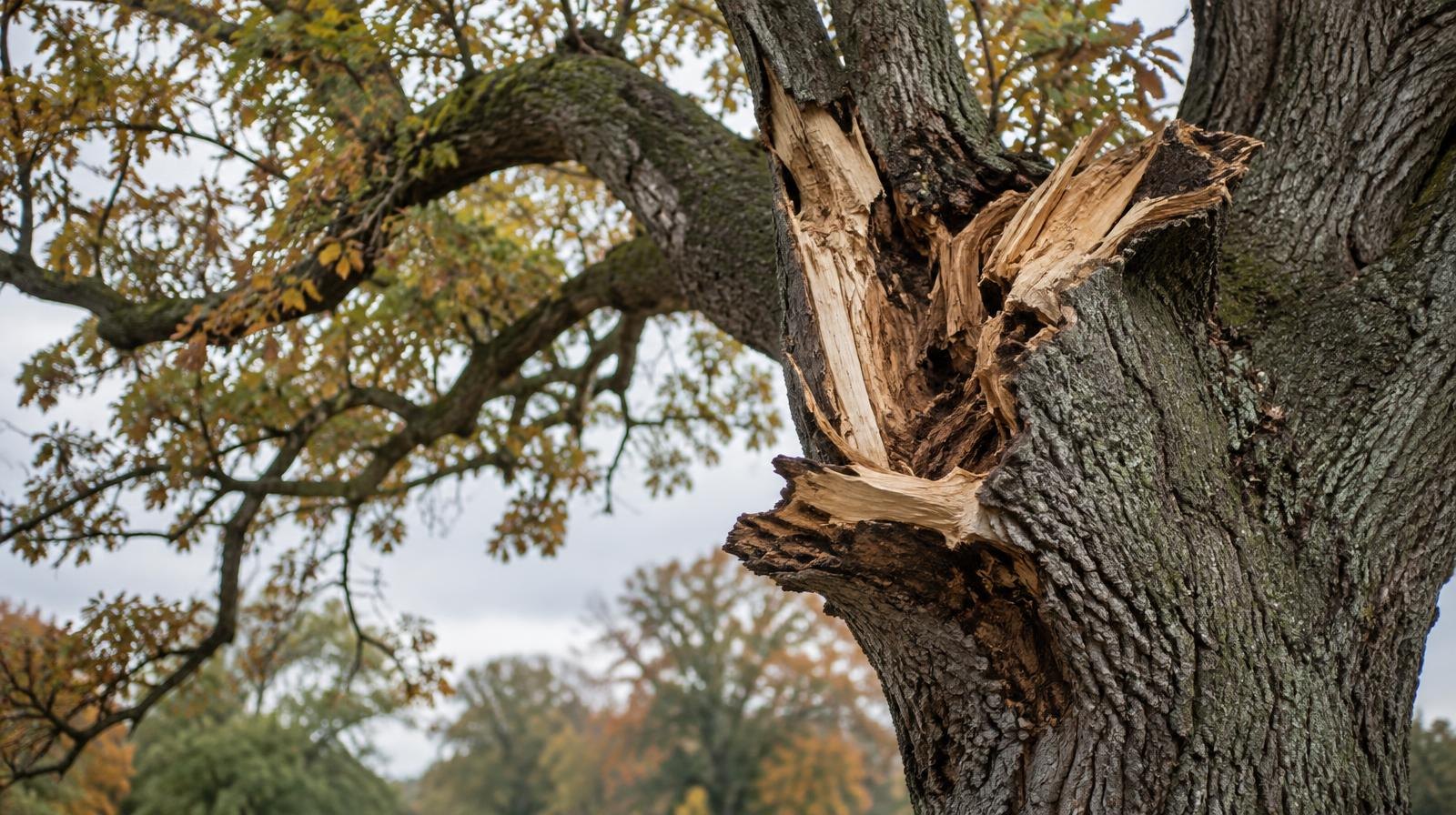
On Sept. 25, wind gusts of up to 54 mph snapped a branch 24 inches in diameter from the tree's southwest side. It struck another 20-inch branch below it, and both hit the ground. The tree sits near 7525 Old Highway 99 in a city right of way.
Master arborist Christine Johnson of Todd Prager & Associates conducted a risk assessment four days later. She told the commission the tree lost 32% of its canopy and now has two wounds estimated at about 5 feet long each and 1 to 2 feet wide. She rated the tree's likelihood of failure as "possible or probable."
Johnson presented three options: retain and manage the tree at a high-end cost of more than $100,000; convert it to a wildlife snag for $6,000 to $12,000; or remove it entirely for $20,000 to $35,000.
She said the tree's risk could be reduced without removing it. Retention would include reduction pruning, a supplemental support system, root zone management and continued monitoring. It would also mean restricting the highway during severe weather, reinstalling fencing, removing some parking spaces at a nearby hangar and relocating a power pole and lines.
The wildlife-snag option would cut the tree to 70 feet or lower, likely causing it to die. Johnson said the tree currently hosts bees in its lower trunk, squirrels that eat its nuts and nesting birds, including kestrels.
Delayed maintenance drew criticism
Arborist Ray Gleason, speaking during public comment, said a February 2025 assessment by Prager & Associates had identified branches on the southwest stem with poor attachments and recommended pruning to reduce failure risk. Instead, the treatment schedule prioritized soil work and pushed pruning to 2027 or 2028.
"My professional opinion is that the sequence was backward," Gleason said.
Assistant City Administrator Kelly Adams said the commission approved the treatment plan in March, with the first year focused on root zone work. A severe drought over the summer delayed that work, now rescheduled for November. Years two and three call for pruning and further assessment.
Shipley said little had been done beyond the initial study and removing a chain-link fence. He blamed that partly on previous city leadership.
Commission chose preservation
Commissioner Don Trosper said he was torn but would hate to see the tree turned into a wildlife snag. The commission's goal, he said, is to honor history and heritage.
The tree, named after conservationist John Davis and settler Ezra Meeker, is on Tumwater's Register of Historic Places. It is believed to have been a trail marker on the historic Cowlitz Trail, according to The JOLT.
The oak has been at the center of a legal fight. Former Mayor Debbie Sullivan ordered its removal after an earlier branch failure but reversed course after community pushback. A lawsuit followed in May 2024, ending with a court order requiring approval from both the Historic Preservation Commission and the Washington Department of Archaeology and Historic Preservation (DAHP) before any alterations.
The city must still go through a DAHP permitting process for the pruning work, Adams said.
The City Council work session is scheduled for Tuesday, Oct. 27, at 6 p.m.